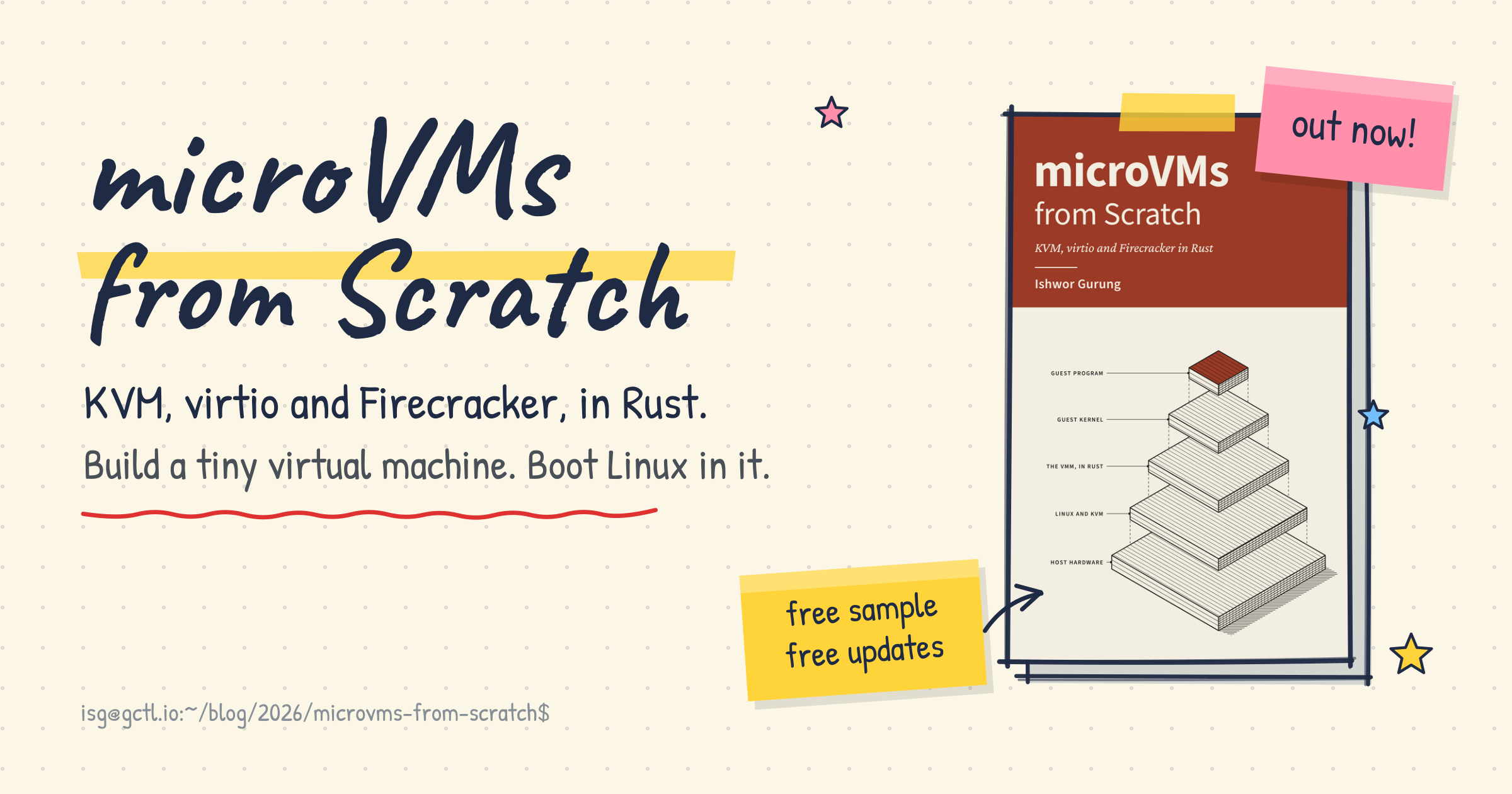
My book is out! 🎉 It is called microVMs from Scratch: KVM, virtio and Firecracker in Rust, and you can get it on Leanpub today.
If you have ever called an AWS Lambda function, a tiny virtual machine started, ran your code and was thrown away. That small machine is a microVM. The book is about how one works, and you learn it the slow, honest way: by building one.
🤔 Why I wrote it
I kept running into the same wall. The pieces of this subject are all out there, and many of them are excellent: Intel’s manuals for the CPU, the kernel’s KVM documentation, the virtio specification, and the source of Firecracker and Cloud Hypervisor. Each one answers its own question well.
What I could not find was a book that glued them together. Something that starts at the CPU and walks, in one voice and one story, all the way up to a real microVM that boots Linux. Learning it meant joining the pieces myself. So I wrote the book I wish I had been handed at the start.
🧭 What is in it
The book climbs one layer at a time. Each chapter explains the idea it needs, in plain words, and then uses it.
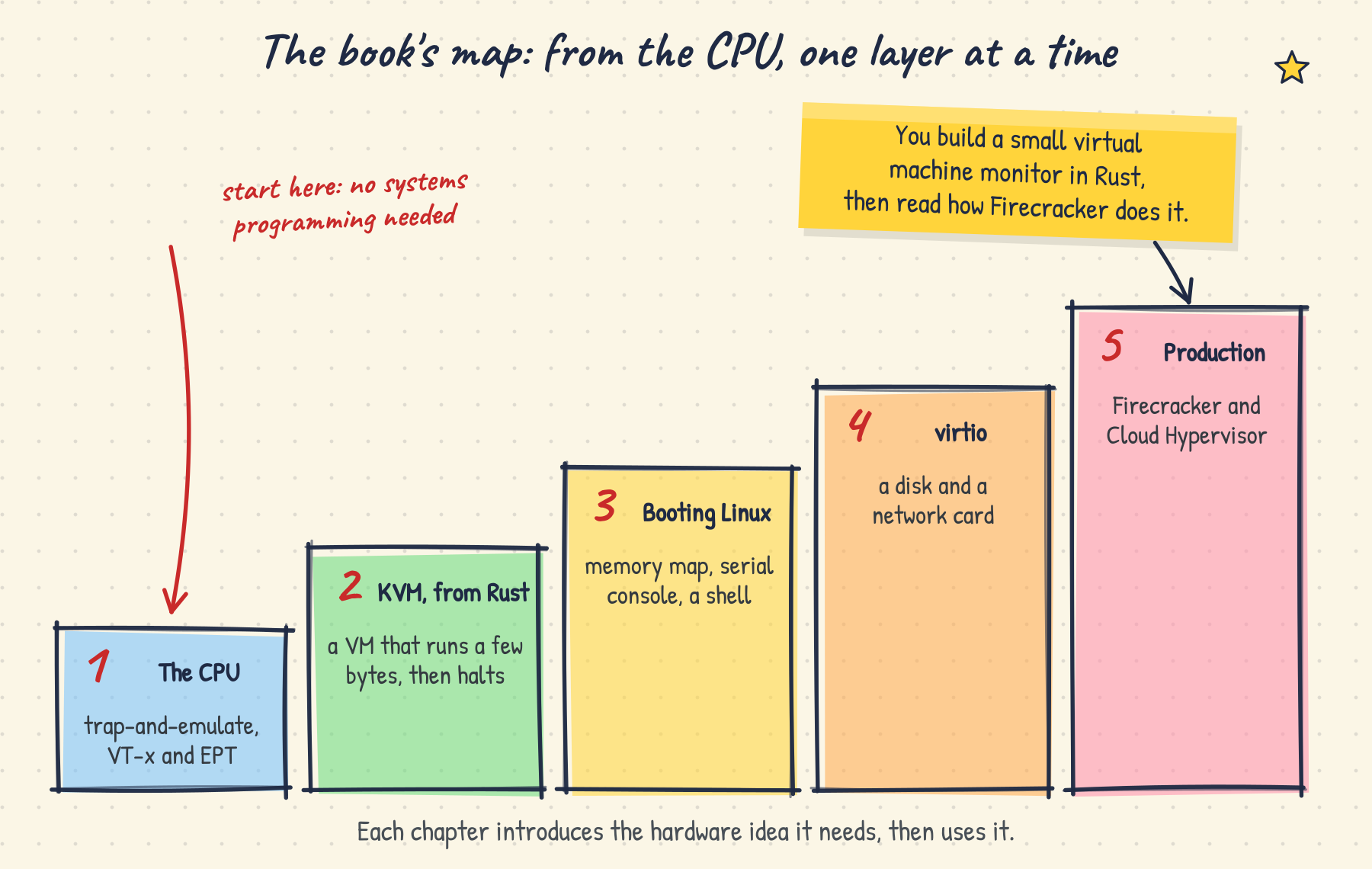
- The CPU. What a virtual machine is at the level of the chip, and how Intel’s hardware support (VT-x) made it fast.
- KVM, from Rust. How a normal Linux program asks the kernel for a virtual machine, and runs a few bytes of code inside it.
- Booting Linux. Getting a real kernel to start inside your own little machine and give you a shell.
- virtio. Giving that machine a disk and a network card, the way real microVMs do.
- Production. A tour of how Firecracker and Cloud Hypervisor are built, mapped back onto the small one you wrote.
A few words, in case they are new. A VMM (virtual machine monitor) is the program that runs a virtual machine. KVM is the part of Linux that lets an ordinary program do that. virtio is the common way a guest and its host share fast devices. Firecracker is the microVM monitor behind Lambda. The book explains each of them from scratch, so you do not need to know them yet.
It is written for software engineers who have not done systems programming. If you have used Docker or a cloud VM and you are curious what is underneath, that is you. To follow along you need a Linux computer on an x86-64 chip, and from chapter 2 on, access to /dev/kvm. The book shows you how to check.
🔗 The code is open
Everything you build in the book is in a public repository, so you can read it, run it and change it: microvm-book-source (MIT licence). The book itself is the paid part. It is the story that connects the code, and the reasons behind every step.
If you read my post on cocoon, which runs Claude Code inside a tiny VM on Cloud Hypervisor, this is the book about what is going on underneath it.
🔄 A live edition
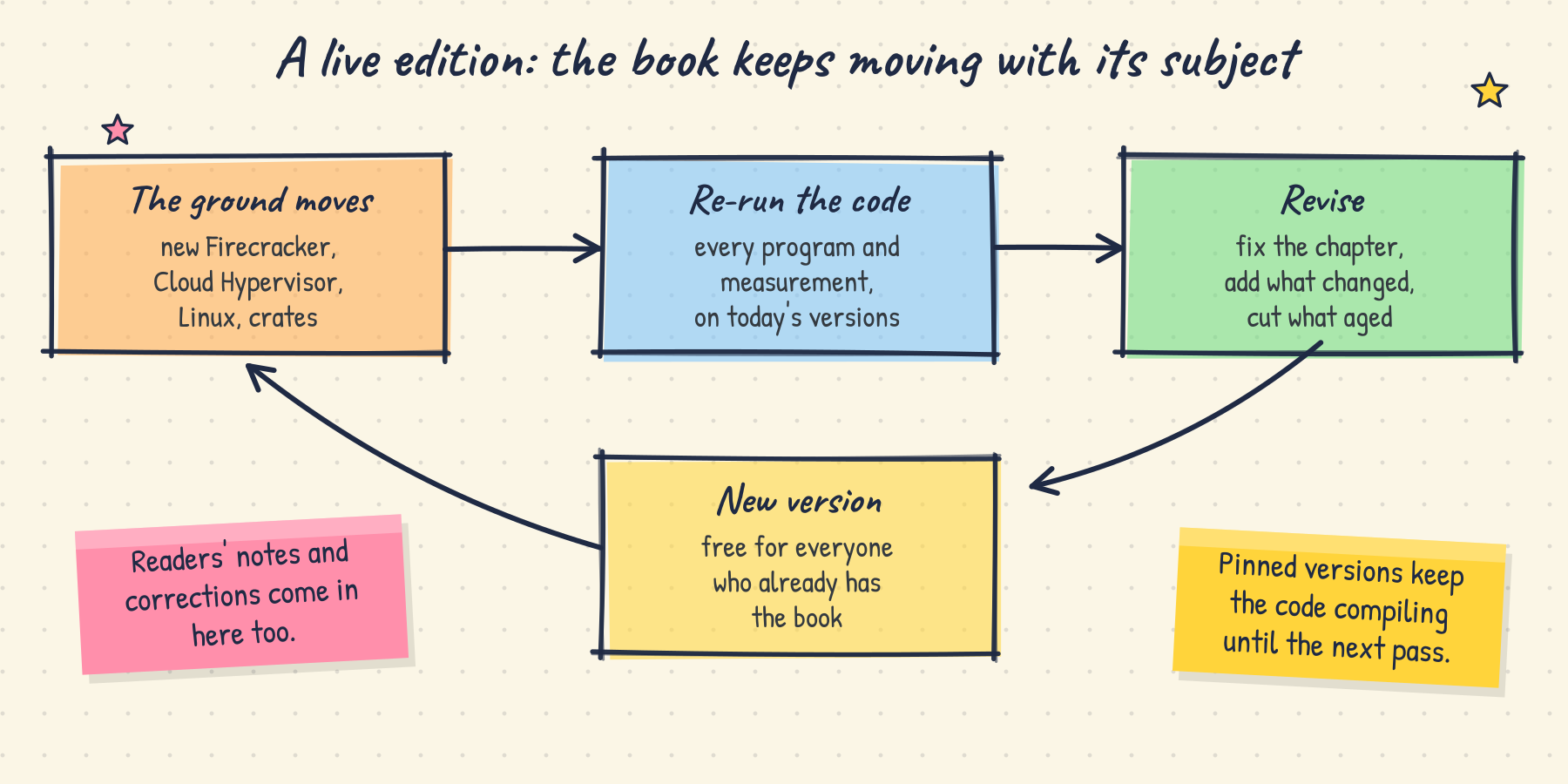
A book about this subject goes stale fast. Firecracker and Cloud Hypervisor release new versions, the Rust libraries change, and Linux keeps moving. A frozen book would slowly stop matching what you see on your own screen.
So I am treating this one as a live edition. My plan is to keep going back: re-run the code, check it against newer versions, fix what I got wrong, add what changed and cut what has aged. Leanpub makes this easy, because everyone who has the book gets the new versions for free.
This is the second edition, from November 2026. It is a fast-iterated cut of the first, and I would rather ship and keep improving than wait for perfect. It will still have mistakes. If you find one, or something is unclear, or a section should go deeper, please tell me. The Leanpub page has a way to contact me, and your notes feed straight into the next revision.
📚 Where to go next
- 📖 The book: leanpub.com/microvm-book. There is a free sample on the page, so you can try the style before you buy, and Leanpub offers a 60-day money-back guarantee.
- 💻 The code: github.com/ishworgurung/microvm-book-source.
Thank you for reading, and if you build a microVM of your own, I would love to hear how it went.
Point-in-time (21 November 2026): second edition, as listed on Leanpub today. The price, the formats and Leanpub’s terms are theirs and can change, so check the book’s page for the current details.